The need to comply with USCIS requirements
Certified translations are essential for clients needing to submit translated documents to a law office. This requirement arises in various scenarios, such as submitting translations to immigration offices, governmental entities, courts of law, or as part of university admission processes. In these fields, the responsibility for accuracy rests on the individual providing the translation. Given that only certified or notarized translations are accepted in such contexts, it is common for people to seek out “certified translation services near me.” Fortunately, numerous companies can fulfill these needs online, delivering precisely what is required.
Meeting USCIS requirements is paramount when translating documents for immigration purposes, particularly for official records like financial statements and academic transcripts. Professional translation services ensure both accuracy and reliability, effectively bridging language barriers and achieving the high quality expected for legal translations. Expertise in academic translation and the provision of superior translation services are critical for official purposes, highlighting the importance of customer service and adherence to standard translation protocols.
The accuracy of the translation plays a pivotal role in determining the outcome of the applicant’s case, as law agencies base their decisions on concrete facts. Consequently, they must be confident that the translation is an accurate reflection of the original document. A client may attempt to create a translation that serves their interests, potentially manipulating key information. To prevent such issues, USCIS prohibits applicants from translating their own documents.
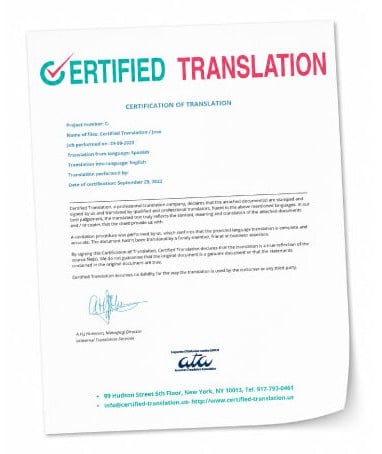
Furthermore, USCIS has instituted additional requirements for documents submitted to their office. Any document not in English must have a translation that mirrors the original in appearance, only rendered in English. This translation must be accompanied by a “certificate of accuracy” from the translator or translation agency, which assumes responsibility for the translation’s content and certifies the accuracy of the provided information.
In conclusion, whether for legal, academic, or immigration purposes, certified translations are indispensable. Professional translation services not only ensure compliance with stringent requirements but also provide the necessary certification to validate the translation’s authenticity and precision. This meticulous process underscores the critical role of certified translations in various official and legal contexts, ensuring that every translated document stands up to rigorous scrutiny.